Home Cooked
Written for my grandma; every basic asian writes about home cooked meals~

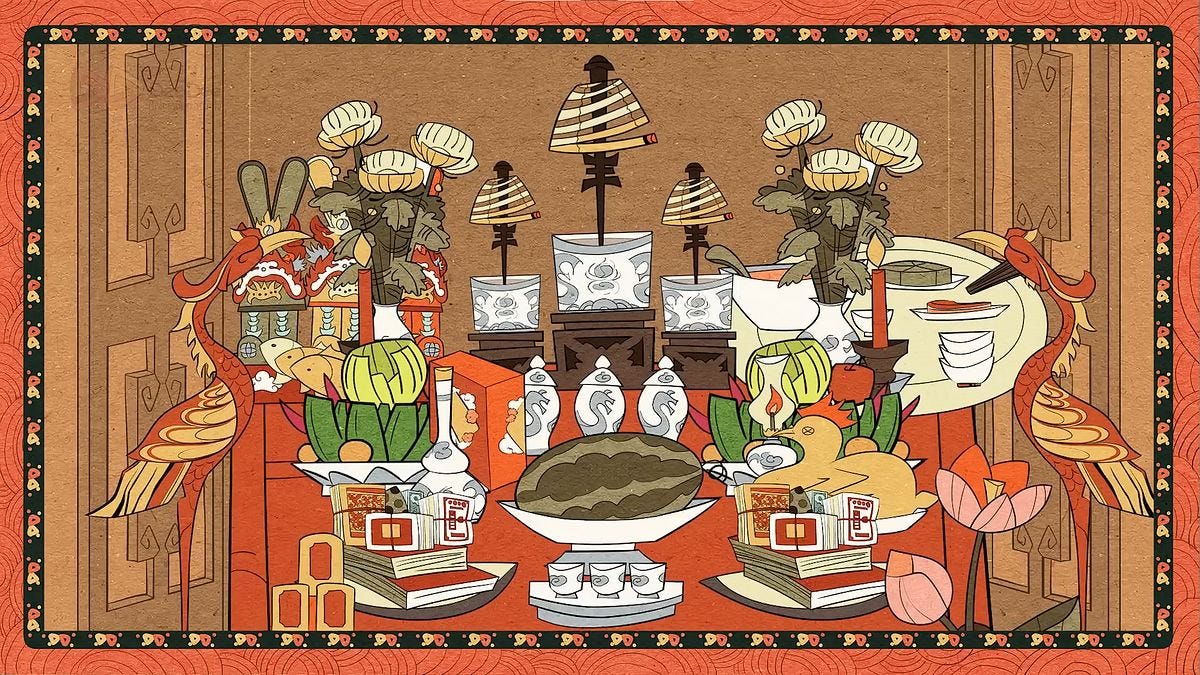
After many years away, a man comes back to his home village to visit his mother. A few weeks ago, he received a letter pleading for his return. His mother is sick, the letter said; she doesn’t have much longer. Thus he finds himself at the dirt path that leads to the village.
Deep in the valleys of the mountain, far away from the commotion of urban life, the path leads to a small clearing where the village resides. The village consists of a couple dozen or so houses on stilts, walls made of teakwood, roofs made of thatching. Clusters of banana trees grow between the houses. In this part of the valley, a river slithers between the foothills of the mountains. Men and their sons wade through the water, dragging a large net so as to catch fish. Around the river are the rice terraces, steps in the mountains big enough for a giant to walk on. A couple of yoked water buffalo plow the rice fields. Around the village children run. They throw rocks at each other and stomp on innocent ants. Groups of young chickens chase one another. A rooster crows. Dogs bark at one another. Somewhere above, a cat jumps from the rooftop. One woman sits under the shade of a tree and weaves together a bamboo basket. Another woman carries cultivated cabbage in a shoulder pole. In the center of the village stands a large stone statue, a Lion-Dog that guards the villagers from malevolent forces. Behind the statue is a communal house, inside of which is the ancestral shrine.
The man climbs up a set of stairs and enters his mother’s house. She is in the corner, resting on a straw mat. A couple of villagers sitting around her, her caretakers, notice the man’s presence and leave. Now the man and his mother are alone. The man wishes they would stay so that he does not have to talk to her alone.
“So you come back,” his mother croaks. Her bony finger points to a ceramic bowl on the floor. “There is longan over there. Take some.” Her voice is hoarse now. In the past she was a beautiful singer, one whose voice led funeral dirges whenever a villager died. She always told the man it was her voice that made his father fall in love with her. But now that voice is gone, along with her beauty. Her hair is thin and stringy, and the crown of her head is bald. She is hardly recognizable. Back when he left the village as a young adult, she had looked the same as she always had.
“Thanks, Ma,” the man says. But he isn’t in the speaking mood. He grabs the bowl and starts peeling the longan. He chews on the sweet flesh of the fruit and tosses the seed out the slatted windows, which evokes a subtle scowl in his mother.
“You look skinny,” she says. “You’re not taking care of yourself.”
“Probably not,” he says.
“I don’t know if I can cook for you.”
“That’s okay, Ma.”
This comment worries the man. If there was one thing the world could never stop his mother from doing, it was cooking. For her to say this, she must truly be sick. Back when he was younger, she spent all of her time cooking. She cooked many things like sweet beef stew with eggs, hearty sandwiches, sticky rice and sausage. She cooked for the entire village practically, and in return they supplied her with ingredients or helped her upkeep the house. She needed this especially when her husband, the man’s father, died. His father died when he was around eight years old. His mother gave his father’s portion of the food to him. You’re a growing boy, she said. You need to eat. At least after his departure she never ran out of mouths to feed.
“I wasn’t sure if you would come back,” his mother says. “It’s been so long.”
“Yes,” the man says. He knows his mother is wondering what he has been up to, but she doesn’t want to say it. He has dedicated his life as a spiritual wanderer. He travels the countryside on a motorcycle. He has trained under and received teachings from the immortal gods of the mountains. He has slain dragons that reign over the night sky with a sword, captured nine-tailed foxes that torment villages, fistfought ogres that pillage innocents. He has made many friends, many enemies, many lovers. Yet these exciting moments hold little attention in his mind. Instead his mind turns to the smaller, more tender moments. He helps the many lost hungry ghosts that haunt the countryside. He locates their remains and brings their bodies back to their home villages so that they may rest at last. And if they do not have a family, he befriends them and becomes their brother. He shares tea with them. Always jasmine tea, the humble man’s tea. And as he sips tea with the ghosts, listening to their tragic stories, he always thinks about the love his mother imbues in every dish, each added spice an extra thought of love.
The man desperately wants to share this with his mother, wants her to know just how much of his life he owes to her, how much of her life lives on in him, that every single thing she has taught him he carries forth with earnestness. But he doesn’t. He can’t.
His mother closes her eyes and turns away from him. “It would be easier if you didn’t show up,” she says calmly. “One day you are under the tutelage of a priest and the next day you are gone. I had already accepted that we would never see each other again.”
The man doesn’t dispute this. If anything, he agrees with her. It is easier to remember her as a distant memory.
“Sorry, Ma,” he says. That’s all he can say. Pathetic.
“I’m tired,” she says. “You can sleep here if you want.”
The man’s mother points at the mosquito net hanging from the ceiling, and understanding immediately, he hobbles on over to drape the mosquito net over her. He stands over her as she falls asleep. It hurts him to hear her phlegmy breathing. He lets out a heavy sigh. Once his mother is asleep, the man contemplates stepping outside and leaving this village for good. He has made his peace; he no longer has any business here. Why drag out this pain any longer? And yet, and yet, the warmth of this house keeps him here. A part of him wants to savor this one last time, he realizes. Besides, he is exhausted. How long has it been since he has slept? A couple days, at least. While he is debating all of this in his mind, whether or not he should stay, he lies down on the floor, his head propped up by his hand, and eventually, his mind drifts off, until he is sleeping.
Once again he is a boy, sleeping in his mother’s house, curled up in a fetal position. He dreams of his mother singing her haunting dirge over his own corpse.
The man awakens to the aroma of star anise, cinnamon, ginger, and the like. As he opens his eyes, he comes to the realization that the straw mat his mother slept on is empty. Adrenaline rushing and sweating, he stands up, eyes wide open. Oh shit, oh shit, he thinks. He runs over to the adjoining room, the kitchen, and finds his mother hunched over a boiling pot of broth. She trembles as she stands. Knowing the dish, the man guesses she has been cooking since he has fallen asleep. He rushes over to stop her, but she refuses.
“Leave me be,” his mother says.
“But Ma,” the man says, “you can barely stand!”
He puts his hands on her shoulders, ready to move her. Her muscles have atrophied greatly. He feels her bones rattle in his hands. She coughs and her entire body shakes. Now it sets in just how frail and old and sick she is. The man frowns. He struggles to admit the inevitable.
“Why can’t you just stay still, Ma?” the man says. “Just rest.”
“Because,” she replies, “if I rest I die.”
So the man lets go of his mother’s shoulders. As he sits at the table, watching his mother cook, she stumbles around the kitchen, finishing all of the preparations. She slices beef flanks into thin pieces. On another space of the counter she chops up herbs. She sweats as she labors and toils, here and there dropping the knife or the food she cuts. Her knife work is sloppier than it used to be, yet behind it is the ghost of graceful mastery. As she cooks the beef in a separate pot of broth, she prepares a bowl of rice noodles. She covers it with beef, pours over the broth, and at last adds the garnishes on top. The man tries to stand up to help carry the bowl over, but his mother refuses; she insists on carrying the bowl over to him.
His mother sets the bowl in front of him. She has only prepared the one bowl, nothing for herself. The man tells his mother to grab herself a bowl, but she says she is not hungry, as she always claims. She has given him a spoon and chopsticks. Like usual, he will not use the spoon. With the chopsticks he grabs a handful of beansprouts and puts it on top of his meal. Alongside this, he pours over the bowl a heaping amount of hoisin sauce, to which his mother chastises him for. It’s too salty, she will say, you will get diabetes, but as always, she lets him do it anyway. The ritual having begun, he starts by slurping the broth-soaked noodles. The broth splatters all over his shirt. Next he chews on the beef. Then he munches on the crunchy beansprouts. Last, he slurps the broth from the lip of the bowl. The man repeats this sequence until the bowl is empty.
As soon as he is finished, his mother grabs him another bowl and places it in front of him. Who is he to deny this? Deep in the second bowl, he tears up. Truly he has never tasted anything so good in his life. Yes. He has tasted cuisine from the gods before, and even those most elegant feasts cannot compare to this. Even on his fifteenth bite, the flavor explodes in his mouth. The only true way to savor this dish is to devour it. How else can you enjoy it? He feels like a little boy once again. A peculiar memory pops up. He remembers when he was ten, he beat up one of the neighborhood kids for stealing his bicycle. Somehow his mother had caught wind of what went down. She probably found out from the old aunties gossiping. That night he showed up back home battered and bloodied. His mother refused to talk to him, refused to even be in the same room as him. Yet before he went to bed, his mother left a bowl of pho out for him.
“It’s very good, Ma,” he says with a mouthful of noodles.
To this his mother says nothing. All she does is watch him eat. Simply, she smiles.